
Maintenance Economics, Resident Comfort, and Data-Driven Asset Management
Abstract. Multifamily property managers operate large populations of distributed heating, ventilation, and air-conditioning (HVAC) assets. In communities served by individual split-system equipment, each apartment may have a separate indoor and outdoor system with unique operating conditions, maintenance history, airflow characteristics, refrigerant side behavior, and resident comfort load. This paper reviews publicly available operating-expense, renter preference, field-service, and HVAC performance research and explains the technical basis for continuous HVAC monitoring as an operational control layer. The central conclusion is that HVAC performance monitoring can support measurable improvements in maintenance triage, first time-fix performance, resident comfort response, asset-risk identification, and capital planning without relying on promotional or anecdotal claims.
Central finding: For multifamily operators, HVAC should be treated as a measurable resident-comfort and asset-performance system, not only as a repair category. Continuous monitoring provides the data structure needed to connect physical system behavior to maintenance productivity, resident experience, and capital planning.
1. Background: HVAC as a Distributed Operating Asset
Multifamily maintenance organizations typically manage HVAC through a combination of scheduled preventive maintenance, resident work orders, technician inspection, vendor dispatch, and equipment-age tracking. This model is functional but incomplete. It captures visible failures and resident complaints, but it frequently lacks continuous evidence of how each system performed before the complaint, how the system responded after service, and whether recurring comfort issues indicate a unit-level problem or a broader property-level pattern.
The scale problem is substantial. A 250-unit property with one split system per apartment may operate 250 separate HVAC systems. A portfolio with 5,000 units may operate thousands of distributed systems across different building vintages, installation practices, exposure conditions, resident usage patterns, and maintenance histories. These systems directly affect thermal comfort, humidity control, resident satisfaction, work order volume, emergency calls, and replacement planning.
2. Evidence Base
2.1 Multifamily repairs and maintenance are material operating costs
IREM national multifamily operating data reported average operating expenses of $8,419.88 per unit annually and repairs and maintenance of $1,152.11 per unit annually in its 2023 national summary. 1 Repairs and maintenance are therefore a material operating category even before HVAC is separated from plumbing, appliances, turns, general repairs, grounds, and contract services.
Industry reporting from the National Apartment Association also describes a constrained operating environment in which repairs and maintenance costs have increased significantly since 2021, pressuring net operating income and management capacity.
2.2 HVAC replacement is a high-value capital exposure
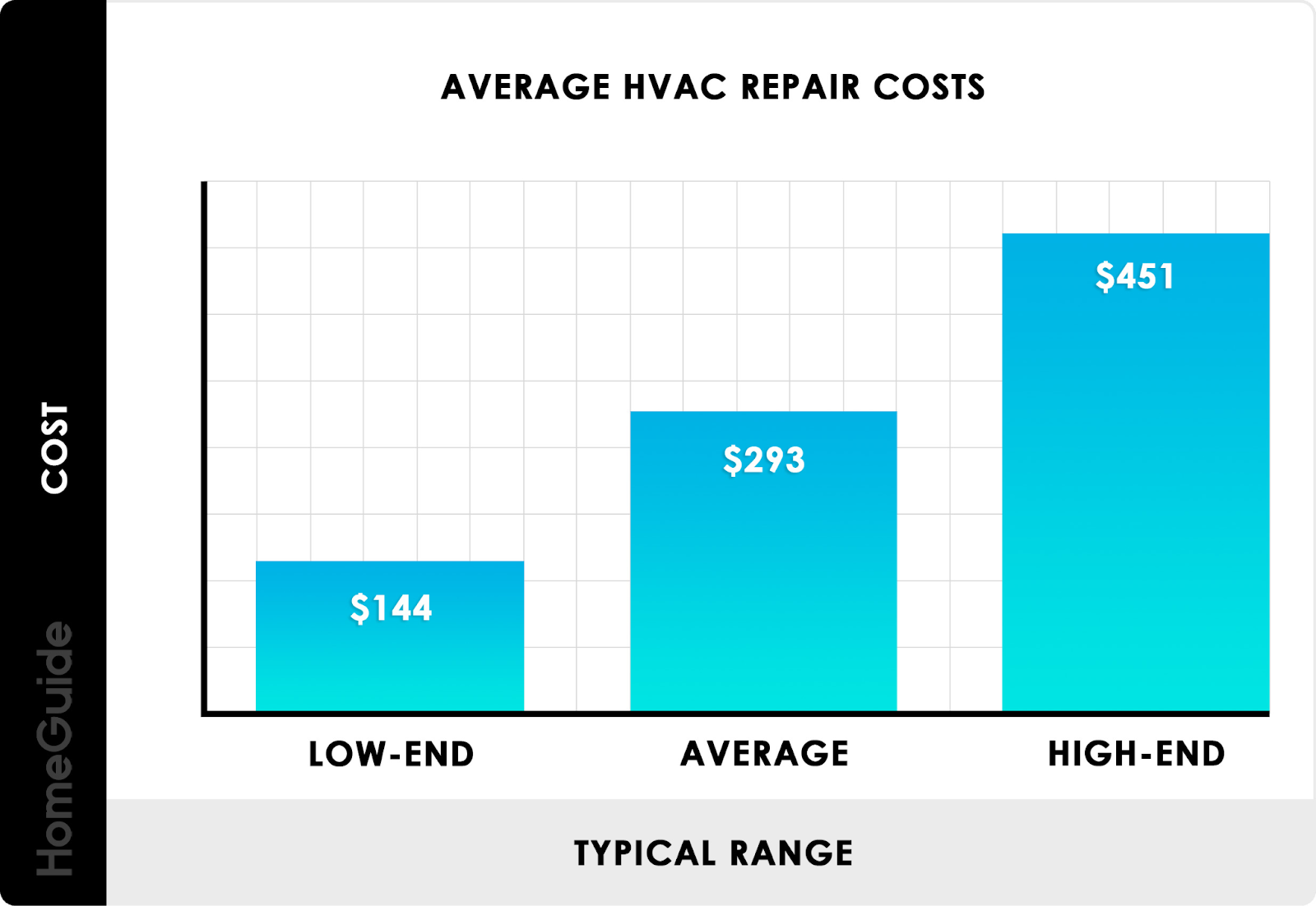
Installed HVAC replacement costs vary by system type, geography, efficiency, access, labor, and installation complexity. Carrier states that HVAC system replacement commonly ranges from approximately $3,000 to more than $15,000, while heat pump replacement can range materially higher depending on configuration. In a multifamily context, those figures are important because each apartment served by a split system represents a separate replacement exposure.
2.3 First-time-fix rate links diagnostics to operating performance
First-time-fix rate is a standard field-service performance metric that measures the percentage of jobs resolved on the initial visit without a return trip, additional parts visit, or follow-up intervention. IBM describes first-time-fix rate as an important key performance indicator because it improves both customer satisfaction and operational efficiency.
For HVAC work orders, first-time-fix performance is heavily dependent on diagnostic clarity. A resident complaint such as “not cooling” may arise from restricted airflow, low refrigerant charge, electrical faults, control-sequence issues, condensate safety interruption, compressor performance, equipment sizing, duct leakage, filter restriction, or intermittent outdoor-unit operation. Without measured data, the technician’s first visit often begins with incomplete information.
2.4 Maintenance satisfaction is associated with renewal and recommendation behavior
Resident-experience research provides a direct operational reason to treat HVAC response as more than a repair event. AppFolio reported that residents satisfied with maintenance were materially more likely to renew and recommend their property manager, and its 2026 renter preferences reporting stated that residents happy with repairs were 81% more likely to renew and three times more likely to recommend their property manager.
This relationship matters because HVAC failures are not low-salience events. Loss of cooling, loss of heating, poor humidity control, and recurring comfort complaints directly affect habitability perception and trust in the property manager.
2.5 Air conditioning and thermal comfort are core renter expectations
The NMHC/Grace Hill 2024 Renter Preferences Survey gathered input from more than 172,000 renters across 4,220 communities and 77 markets. 6 Industry reporting on the survey found that air conditioning was important to 93% of renters, making it one of the most highly valued apartment features.
2.6 Technical HVAC faults have measurable performance consequences
The U.S. Department of Energy recommends that air-conditioning maintenance include checking refrigerant charge, testing for leaks, checking duct leakage, measuring airflow across the evaporator coil, verifying electric control sequence, and inspecting electrical terminals.
Oak Ridge National Laboratory research on residential HVAC fault data notes that refrigerant-charge and airflow faults in residential air conditioners and air-source heat pumps can waste energy and reduce cooling capacity; the report cites findings where even slight undercharge can reduce cooling capacity by nearly 13% and efficiency by 7.6%.
3. Conceptual Framework
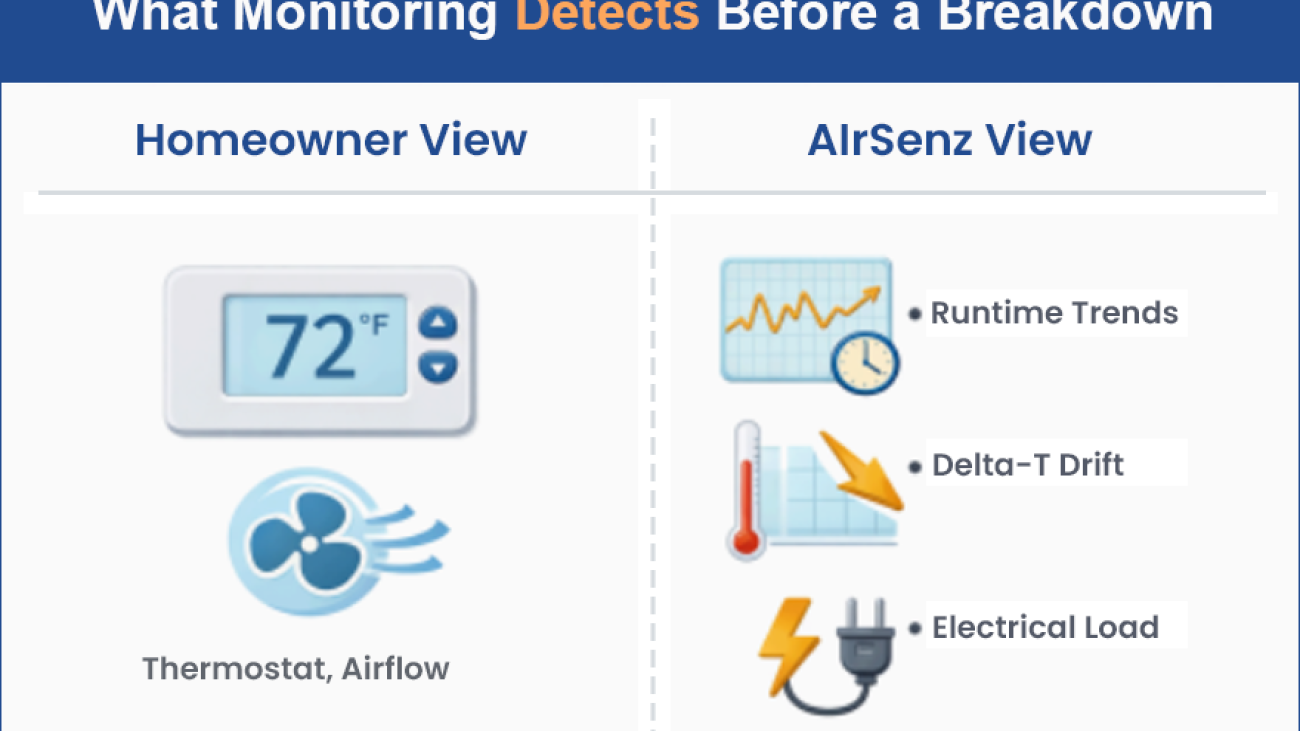
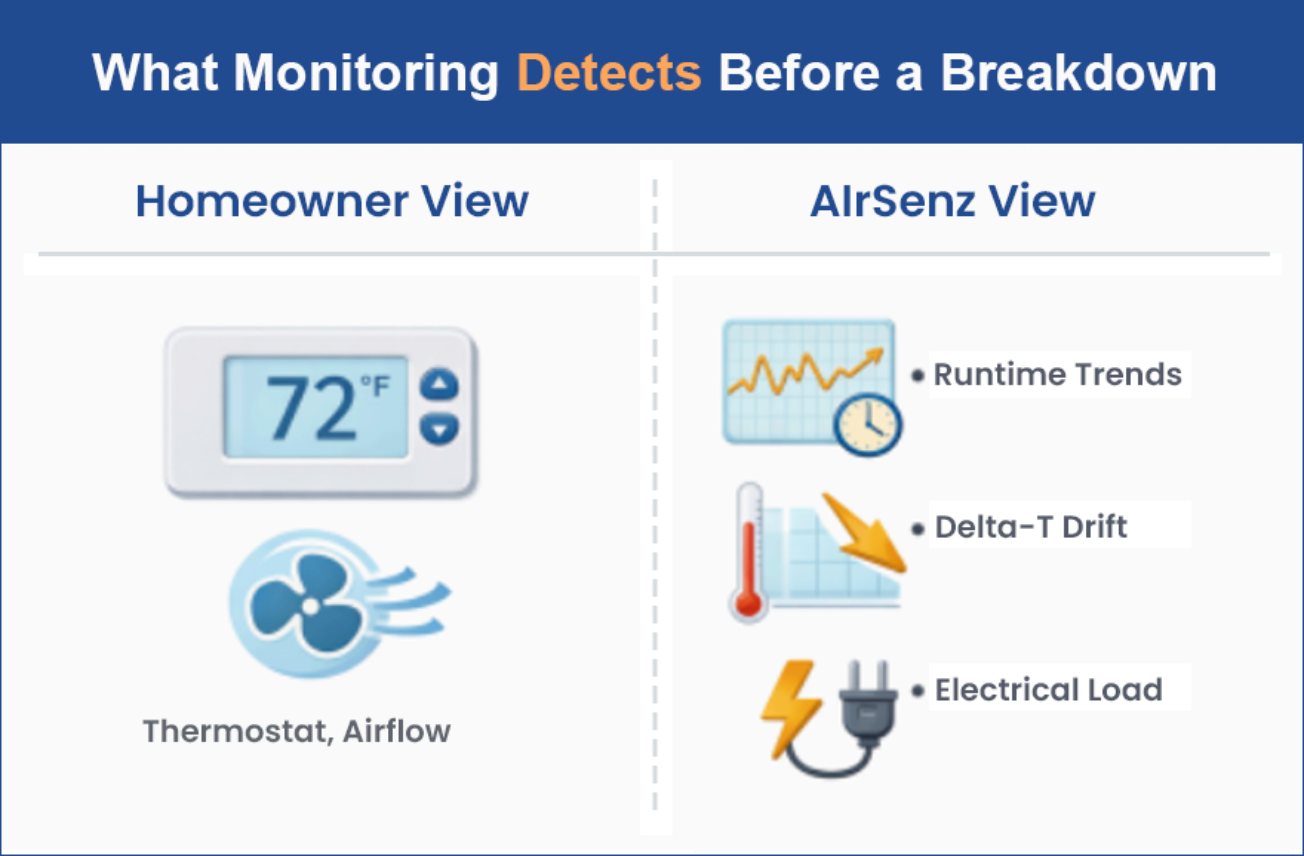
The technical premise of continuous HVAC monitoring is straightforward: comfort outcomes and service outcomes are downstream of physical system behavior. If that behavior is measured continuously, operators can detect abnormal patterns earlier, classify likely fault domains more accurately, and verify whether corrective action restored normal operation.
| Measured condition | Operational interpretation | Maintenance response | Property-management outcome |
|---|---|---|---|
| Airflow / static / pressure behavior | Restriction, duct issue, blower issue, filter effect, commissioning defect | Prioritize airflow-side inspection before refrigerant assumptions | Fewer misdiagnosed comfort calls |
| Temperature and humidity response | Capacity, latent performance, comfort recovery, abnormal runtime | Validate whether system is producing expected comfort response | Improved resident comfort verification |
| Electrical operation | Motor, compressor, staging, cycling, or load anomaly | Route correct technician and parts; verify control sequence | Higher first-time-fix potential |
| Refrigerant-side indicators | Charge, compressor, coil, or heat-transfer fault domain | Escalate to certified HVAC service with evidence | Better triage and lower repeat visits |
Table 1. Conceptual link between measured HVAC behavior and property-management outcomes.
4. AirSenz Technical Role
AirSenz is a distributed HVAC performance-monitoring platform developed for split-system and related unitary HVAC applications. Its function is to observe operational behavior at the system level and convert raw sensor measurements into fault-domain evidence, service context, and asset-performance history.
In multifamily operations, the platform’s technical role can be described in five categories:
Continuous condition observation
AirSenz records system behavior across normal operation, abnormal operation, and post-maintenance recovery. This provides context that is unavailable during a one-time service visit.
Fault-domain classification
Measured variables can help distinguish airflow, refrigerant-side, electrical, controls, humidity, and runtime patterns. The objective is not to replace a technician, but to improve the information available before and during service.
Service verification
After a repair or adjustment, measured performance can be compared against the pre-service condition and
expected operating ranges. This helps determine whether the intervention restored system behavior or merely cleared the immediate complaint.
Asset-risk ranking
Systems with recurring abnormal behavior, long runtimes, poor recovery, abnormal electrical behavior, or repeated comfort complaints can be ranked for deeper inspection or replacement planning.
Portfolio analytics
When deployed across many apartments, the data can identify common fault patterns, chronic units, building-level duct or installation issues, vendor performance differences, and season-specific risk patterns.
5. Operational Mechanisms
5.1 Maintenance triage
A common maintenance workflow begins with a resident complaint. AirSenz adds a measured-data layer to that workflow. Instead of treating “not cooling” or “not heating” as a generic symptom, the operator can review evidence of airflow response, temperature change, humidity behavior, electrical operation, runtime, and equipment state. This supports better triage and escalation decisions.
5.2 First-time-fix improvement
Because first-time-fix rate depends on diagnosis, parts readiness, and technician routing, pre-dispatch data can influence whether the correct skill set and tools arrive on the first visit. For example, an airflow-indicated event may justify filter, blower, duct, or obstruction inspection before refrigerant service is scheduled; an electrical pattern may justify capacitor, contactor, motor, or control-sequence evaluation.
5.3 Resident comfort assurance
Resident comfort is both a physical condition and an experience outcome. The physical side includes temperature, humidity, capacity, airflow, and recovery time. The experience side includes response speed, communication, confidence, and recurrence. AirSenz supports the physical side by measuring system behavior and supports the experience side by giving property teams better evidence for status communication and resolution verification.
5.4 Capital planning
Age-based replacement planning is useful but incomplete. A ten-year-old system that is operating within normal performance ranges may be less urgent than a newer system with repeated abnormal behavior. Continuous monitoring allows owners to add condition evidence to replacement planning, reducing dependence on age alone.
6. Scientific and Operational Hypotheses
For website publication, AirSenz should be described through testable operational hypotheses rather than unqualified claims. The following hypotheses are consistent with the evidence base and can be measured in managed properties:
| Hypothesis | Measurement approach | Expected direction of effect |
|---|---|---|
| Continuous HVAC monitoring improves maintenance triage. | Compare diagnostic category assigned before dispatch against final technician diagnosis. | Higher diagnostic agreement and fewer unnecessary escalations. |
| Measured HVAC evidence improves first-time-fix performance. | Track repeat work orders within 7, 14, and 30 days by monitored vs. unmonitored systems. | Lower repeat-ticket rate and higher first-time completion. |
| Post-service verification reduces unresolved comfort complaints. | Compare comfort complaints after service and measured recovery after repair. | Fewer recurring comfort complaints. |
| Condition evidence improves replacement prioritization. | Compare replacement decisions based on age alone versus age plus performance indicators. | More planned replacements and fewer emergency replacements. |
| Comfort-critical monitoring improves resident experience. | Track resident satisfaction after HVAC work orders and time to verified restoration. | Higher satisfaction and shorter unresolved-comfort duration. |
7. Measurement Architecture
A rigorous HVAC monitoring program should avoid vague claims and instead use consistent operational definitions. The following metrics create a research-grade measurement structure for evaluating HVAC performance in property operations:
| Metric domain | Primary metric | Operational definition |
|---|---|---|
| Service productivity | First-time-fix rate | Percentage of HVAC work orders resolved without repeat visit or related follow-up ticket within a defined window. |
| Resident impact | Time to comfort restoration | Elapsed time from resident complaint to verified return to acceptable thermal performance. |
| Maintenance recurrence | Repeat HVAC ticket rate | Related HVAC work orders for the same unit within 7, 14, or 30 days. |
| Asset condition | Abnormal performance frequency | Count and duration of out-of-range airflow, temperature, humidity, electrical, or refrigerant-side indicators. |
| CapEx risk | Condition-prioritized replacement list | Ranking of systems by recurring faults, age, runtime, service history, and performance degradation. |
| Resident experience | Post-work-order satisfaction | Resident score following HVAC issue resolution, segmented by system condition and response time. |
Table 3. Recommended measurement architecture for HVAC performance monitoring in property operations.
8. Implications for Property Operations
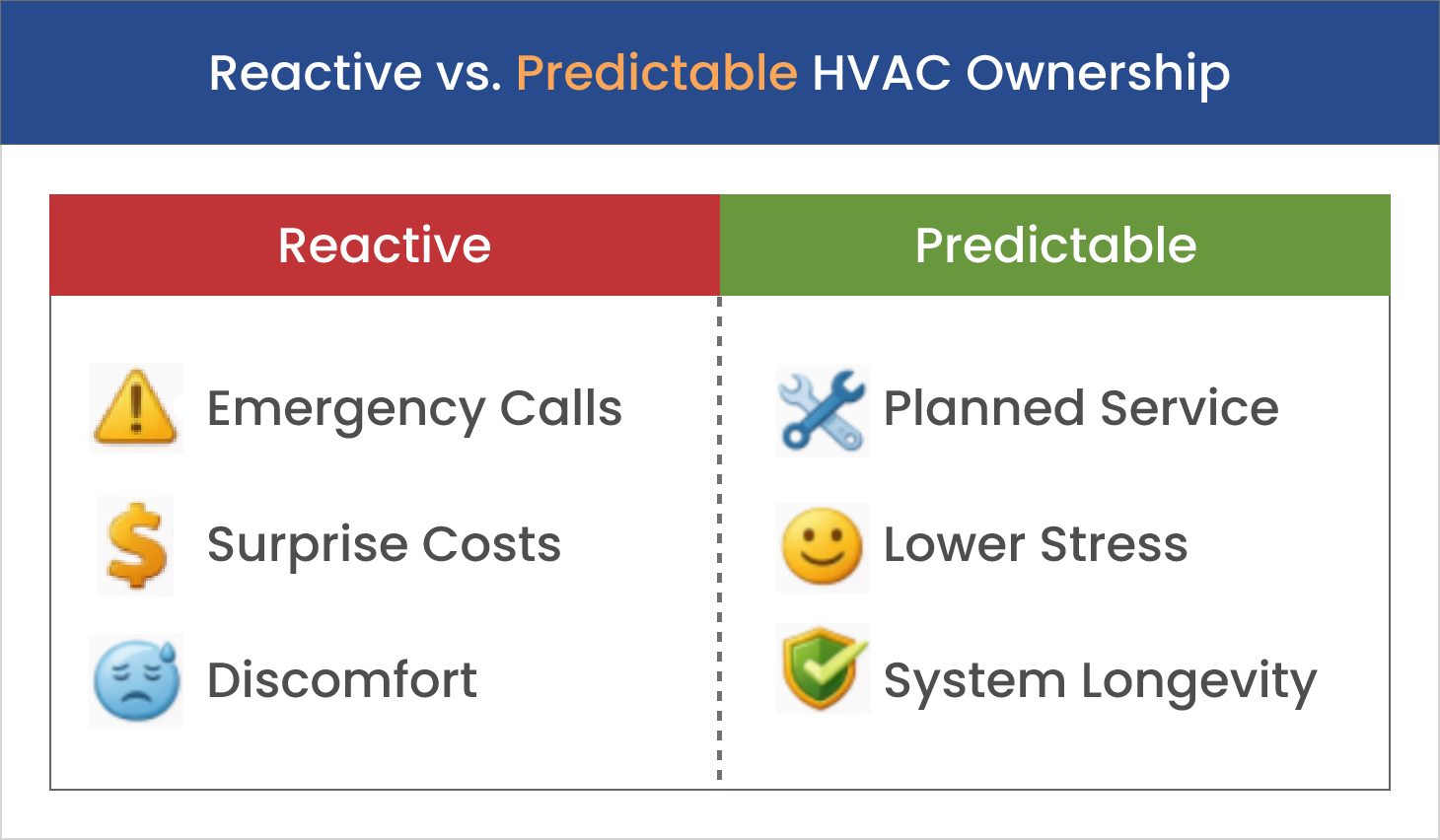
The evidence reviewed in this paper supports a conservative conclusion: HVAC performance monitoring is best understood as an operational instrumentation layer. It does not eliminate maintenance labor, replace licensed HVAC judgment, or guarantee resident retention. Its value is in reducing information asymmetry between the system, the resident, the property manager, and the technician.
In practical terms, that information layer can improve property operations in four ways. First, it can reduce diagnostic ambiguity by identifying the likely fault domain before dispatch. Second, it can improve service accountability by verifying whether the system returned to expected operation after maintenance. Third, it can support resident experience by reducing unresolved comfort duration and enabling clearer communication. Fourth, it can improve capital planning by identifying systems that are deteriorating before they fail during peak conditions.
Because renter research indicates that air conditioning is a core resident expectation and maintenance satisfaction is associated with renewal and recommendation behavior, HVAC monitoring should be evaluated not only as a facilities tool but also as part of resident-experience infrastructure.
9. Conclusion
Multifamily property managers operate in an environment where maintenance costs, resident expectations, labor constraints, and equipment-replacement exposure are all significant. Split-system HVAC assets are particularly important because they are distributed, comfort-critical, expensive to replace, and difficult to diagnose without measured operating data.
AirSenz addresses this structural problem by converting HVAC operation into measurable performance evidence. The scientific rationale is grounded in well-established principles: airflow, refrigerant charge, electrical operation, humidity response, runtime, and temperature recovery are observable indicators of HVAC system condition; first-time-fix rate is a recognized service-performance metric; and resident maintenance satisfaction is associated with renewal and recommendation behavior.
The result is a more rigorous operating model for multifamily HVAC: measured system behavior, evidence- based triage, verified service outcomes, and condition-informed asset planning.
References
1. IREM. Income/Expense IQ 2023 National Summary: Conventional Apartments. Reports national multifamily operating-expense benchmarks, including repairs and maintenance per unit. https://www.irem.org/file%20library/globalnavigation/learning/tools/irem-income-expense-iq-national-summary-23-final.pdf
2. National Apartment Association. “Momentum Management: Navigating Elevated Costs in a Constrained Operating Environment.” Discusses rising multifamily repairs and maintenance costs and NOI pressure. https://naahq.org/news/momentum-management-navigating-elevated-costs-constrained-operating-environment
3. Carrier. “HVAC Replacement Cost.” Provides installed HVAC replacement-cost ranges and notes dependency on equipment type, efficiency, and installation complexity. https://www.carrier.com/us/en/residential/hvac-resources/hvac-replacement-cost/
4. IBM. “What is First-Time Fix Rate (FTFR)?” Defines FTFR and explains its relationship to operational efficiency and customer satisfaction. https://www.ibm.com/think/topics/first-time-fix-rate
5. AppFolio. “Happy Renters, Better Performance: Why Resident Experience Matters Most in Today’s Market.” Summarizes 2026 renter-preference findings on satisfaction, repairs, renewal, and recommendation. https://www.appfolio.com/newsroom/renter-preferences-report-2026
6. National Multifamily Housing Council and Grace Hill. “2024 Renter Preferences Survey Report.” Describes survey scope including more than 172,000 renters across 4,220 communities and 77 markets. https://www.nmhc.org/research-insight/research-report/nmhc-grace-hill-renter-preferences-survey-report/
7. Multifamily Dive. “NMHC survey reveals renters’ top preferences.” Reports that air conditioning was important to 93% of renters in the NMHC/Grace Hill survey. https://www.multifamilydive.com/news/nmhc-survey-reveals-renters-top-preferences/700666/
8. U.S. Department of Energy. “Air Conditioner Maintenance.” Lists recommended maintenance tasks including refrigerant charge, duct leakage, airflow measurement, control sequence verification, and electrical inspection. https://www.energy.gov/energysaver/air-conditioner-maintenance
9. Oak Ridge National Laboratory. “Residential HVAC Fault Data Collection Plan.” Discusses refrigerant-charge and airflow faults in residential air conditioners and heat pumps and their effects on energy and capacity. https://info.ornl.gov/sites/publications/Files/Pub211955.pdf
Note on use: This publication is intended as a technical interpretation of public research and should be updated as proprietary field datasets become available. Quantified impact estimates should be reported only after measurement under defined operating conditions.